

EN
Padel
Retaining Your Padel Players: 10 Effective Strategies
How to Drive Player Retention at Your Padel Club: Discover 10 Proven Strategies to Boost Court Bookings, Re-engage Members, and Grow Your Revenue.

Attracting new players to a padel club is only the first step. Getting them to return regularly is just as critical to the long-term profitability of your facility.
A player who books once a month does not generate the same revenue as one who plays every week. Yet, many club managers still focus most of their efforts on acquiring new members without fully unlocking the lifetime value of their existing player base.
Between one-off bookings, players who churn after a few matches, and members who play across multiple venues, player retention has become a major growth lever for padel clubs.
How do you convert occasional players into regulars? How do you identify members at risk of churning? What strategies can you implement to drive booking frequency without eroding margins through constant discounting?
Discover 10 actionable strategies to retain your players, cultivate a vibrant community, and scale your padel club's revenue.
Why is player retention essential for a padel club's profitability?
A padel club operates with fixed inventory: a set number of courts and daily time slots.
Unlike an e-commerce store, you cannot scale bookings indefinitely without building additional courts or expanding operational hours.
To boost top-line revenue, operators must leverage several key drivers:
Acquiring new players;
Increasing the booking frequency of existing players;
Optimizing court occupancy rates;
Driving ancillary sales (pro shop, bar, food & beverage);
Minimizing off-peak downtime.
Among these levers, retention offers a unique ROI advantage: you have already established a relationship with these players.
They know your facility, have experienced your courts, and likely already have an account on your app.
The customer acquisition cost (CAC) and effort required to bring them back are significantly lower than converting a first-time prospect.
The core metric: Player Lifetime Value (LTV)
Let's look at an illustrative example.
A player books an average of one court session per month at €36 at your club.
Over a full year, this generates:
12 bookings × €36 = €432 in annual court revenue.
If you encourage that same player to book twice a month:
24 bookings × €36 = €864 in annual court revenue.
You have doubled the direct revenue from this user without spending a cent on new customer acquisition.
This calculation reflects total court revenue billed by the club, rather than individual spend per player, and assumes additional bookings utilize vacant capacity without cannibalizing other bookings.
Across a database of hundreds or thousands of active bookers, small improvements in booking frequency compound into substantial bottom-line growth.
How to measure player retention in a padel club
Before launching a retention strategy, you need clear visibility into your customer behavior.
A club might have 5,000 registered user accounts but only 800 genuinely active players.
Conversely, a facility with a smaller but highly committed player base can drive exceptional booking volumes.
Relying solely on total registered user counts is a vanity metric.
1. Booking frequency
This is one of the most critical operational KPIs.
Average frequency = Total bookings / Active bookers over a given period.
For example:
600 monthly bookings;
300 unique accounts that booked at least once.
The average booking frequency is 2 bookings per active account per month.
Note: If your system only tracks the player making the reservation and payment, this metric may not capture the true playing frequency of all four court participants.
Whenever possible, leverage a system that records both the booking organizer and all tagged participants on the court.
2. Retention rate
This metric tracks the percentage of players who return following their initial visit or cohort period.
Example:
You identify 100 new first-time bookers in January.
Of those, 40 book again in February.
Your 30-day cohort retention rate is 40%.
Maintaining a standardized calculation method over time is essential for tracking progress.
3. Reactivation rate
This measures the percentage of dormant players who return to book a court.
For example:
200 players have not booked in 60 days;
30 make a booking following a targeted re-engagement campaign.
Your observed reactivation rate is 15%.
To isolate the true campaign lift, measure this performance against a control group that did not receive the communication.
4. Average Revenue Per Active User (ARPAU)
Finally, evaluate total spend across your active member base.
This should encompass:
Court bookings;
Memberships and subscriptions;
Coaching and clinics;
Tournaments and league fees;
Pro shop equipment sales;
Clubhouse bar and catering revenue.
This provides a comprehensive view of the true commercial value of your sports community.
1. Turn first-time bookings into regular habits
Retention starts on day one.
A player visiting your club for the first time needs a compelling reason to book their next match quickly.
Court quality, warm hospitality, and a premium playing experience are prerequisites.
However, the customer onboarding journey must also be proactively managed.
Seamlessly guide players toward their next reservation
After a first match, don't leave the next booking to chance.
Automate touchpoints to offer:
A recommended slot for the following week;
A coaching session tailored to their skill level;
An upcoming social mixer to meet other players;
An introductory discovery package;
A prepaid booking pack.
The goal is to eliminate friction and prompt immediate re-engagement.
Post-booking communication example
"Thanks for playing with us today! Ready for your next match? View upcoming open court slots directly in your booking app."
Keep communications concise, context-aware, and aligned with each user's marketing consent preferences.
Eliminate booking friction
If a customer has to navigate confusing price lists or re-enter payment details every time they visit, booking friction increases churn risk.
Deploying dedicated padel club management software streamlines scheduling and turns repeat reservations into a one-click process.
The smoother the digital experience, the faster your club becomes part of their regular sports routine.
2. Segment your player database for personalized retention
Generic, one-size-fits-all messaging fails to engage modern sports consumers.
A player booking three times a week has entirely different expectations from someone who played once six months ago.
Yet, many facilities continue to blast the same blanket newsletter to their entire database.
A high-performing CRM strategy requires granular customer segmentation.
Segmentation framework for padel facilities
Segment | Benchmark Criteria | Primary Objective |
|---|---|---|
New Players | First booking within the last 14 days | Drive the 2nd booking |
Occasional Players | 1 booking per month | Increase frequency |
Regular Players | 2–4 bookings per month | Reinforce the habit |
Power Users | Weekly or multi-weekly bookings | Build loyalty & advocacy |
At-Risk / Dormant | No booking in 30–60 days | Reactivate |
Churned Players | No booking in 90+ days | Gather feedback & win back |
These criteria serve as guidelines and should be calibrated to your club's operational baseline.
For instance, a bi-weekly player should not be flagged as dormant after just three weeks of inactivity.
The most powerful insights come from tracking individual behavioral shifts.
A member who consistently played twice a week but hasn't booked in 30 days warrants immediate attention compared to an infrequent user who visits once a quarter.
3. Introduce recurring memberships and prepaid credit packs
Memberships and credit bundles are proven tools to lock in regular play.
They commit the player upfront to future court time while delivering predictable cash flow and stronger lifetime value for the operator.
Consider three core models:
Prepaid credit packs
For example:
10 court hours purchased in advance, bundled with a preferential rate or perks.
Players maintain a running credit balance they can draw down seamlessly.
This guarantees advance revenue and reduces friction for future bookings.
Ensure transparent terms: expiry dates, peak vs. off-peak eligibility, and cancellation rules.
Recurring monthly subscriptions
Tier your membership plans with exclusive value-adds:
Discounted court rates;
Priority booking windows (e.g., reserve 14 days in advance instead of 7);
Coaching discounts;
Pro shop perks;
Complimentary racket rentals or locker access.
Tailor your membership structure to match court demand and utilization rates.
Standing weekly court reservations
Many regular groups want the same court at the same time every week.
For example:
Every Thursday at 7:00 PM.
Contracted standing slots secure recurring revenue and solidify playing habits.
Maintain strict utilization controls to ensure prime-time inventory remains accessible for general play and new user acquisition.
Balance recurring revenue with peak-hour court availability to maximize overall yield.
4. Reactivate dormant players with targeted campaigns
A member who hasn't played in several weeks is not necessarily lost forever.
They may have faced schedule changes, struggled to coordinate partners, or simply drifted away from their routine.
Proactive automated win-back workflows allow you to re-engage them before they churn permanently.
Segment by inactivity stages
Set up dynamic stages based on time since last booking:
No booking in 30 days
→ Share club updates, new court openings, or upcoming social mixers.
No booking in 60 days
→ Recommend a clinic, open match, or targeted time slot.
No booking in 90 days
→ Deploy a targeted win-back offer or feedback survey.
Calibrate these intervals against your facility's natural booking cadence.
Select the right communication channels
Leverage multi-channel automation based on user preferences:
Email;
SMS;
Mobile push notifications.
Re-engagement does not require margin-diluting discounts.
Often, relevant updates are enough to prompt action:
A new training clinic opening up;
An upcoming tournament registration launch;
Available court slots during their preferred playing times;
A social mixer looking for players in their rating tier.
Win-back messaging template
"We haven't seen you on the court lately! We're hosting an intermediate mixer next Tuesday that matches your level. Want to jump in?"
Personalized, data-driven touchpoints consistently outperform generic mass promotions.
To automate this workflow, explore DoinSport's retention and communication suite, designed specifically to manage member segmentation, automated emails, SMS, and push notifications.
Ensure all campaigns comply with local privacy regulations (such as GDPR) and provide easy opt-out mechanisms.
5. Deliver a seamless mobile booking experience
Customer retention is heavily driven by user experience (UX).
If booking a court is complicated, players will migrate to competitors who offer greater convenience.
Consider two competing clubs with comparable courts.
At Club A, players must call the front desk or navigate a clunky web portal.
At Club B, they open a branded mobile app, check real-time availability, split the payment, and book in under 30 seconds.
UX directly drives booking frequency and venue loyalty.
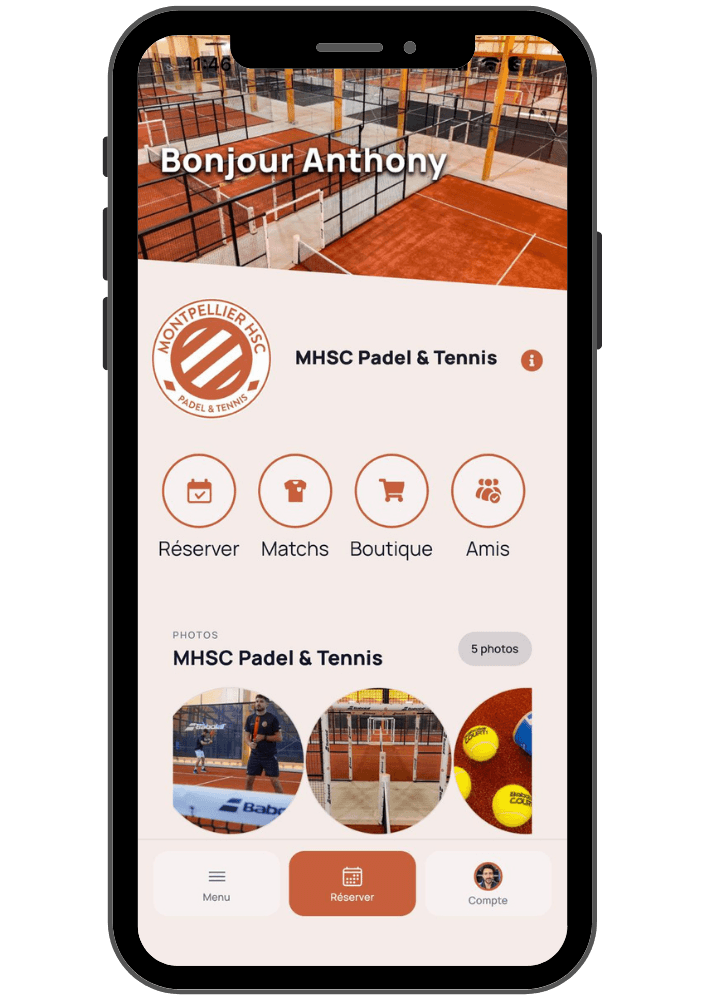
A white-label mobile app for your club
A customized mobile app keeps your brand front and center on your players' home screens.
Players can easily:
Check real-time court availability;
Book and split payments with partners;
Process secure mobile transactions;
Redeem prepaid credits;
Manage active subscriptions;
Sign up for tournaments and leagues;
Follow club news and leaderboards.
Beyond online scheduling, your mobile app is a direct retention channel.
It functions as a proprietary communication hub for your sports community.
Use push notifications to alert players about open match slots, club tournaments, or off-peak booking specials.
A custom-branded mobile app for padel clubs reinforces your brand identity rather than routing your audience through a third-party aggregator platform.
For operators aiming to build lasting enterprise value, owned customer touchpoints are an essential asset.
6. Build an engaged, social club community
Padel is inherently social.
Retention is rarely driven by court quality or pricing alone.
Players return for the social atmosphere:
Their regular playing partners;
Their network of friends;
Competitive matchups at their exact skill level;
Trusted coaches;
The clubhouse and bar culture.
A facility with a thriving community becomes an indispensable lifestyle destination, not just a sports court.
Organize level-based open matches
One of the biggest friction points for amateur players is finding three other players at an equal skill level.
Eliminate this barrier by managing matchmaking:
Beginner clinics & round-robins;
Intermediate open matches;
Competitive king-of-the-court ladders;
Skill-rated mixers;
Introductory discovery sessions.
Connecting unaligned players expands their internal playing network and drives consistent booking volume.
Elevate the post-match experience
The clubhouse, pro shop, and post-game social atmosphere are key retention drivers.
Players remain loyal to clubs where staff and members know them personally, even when competing facilities open nearby.
Retention extends beyond the 60 minutes spent on court.
For deeper insights into refining every touchpoint, read our guide on mastering the customer experience in padel clubs.
7. Deploy a high-ROI loyalty rewards program
A successful loyalty program is not about handing out margins.
It should be engineered to incentivize behaviors that generate high lifetime value for your club.
Reward high-value player actions such as:
Consistent weekly bookings;
Tournament and clinic participation;
Purchasing credit packs or memberships;
Referring new paying players;
Booking off-peak or hard-to-fill court hours.
Reward consistency
Structure milestone-based tiers tied to booking activity.
For example:
5 bookings → Pro shop voucher
10 bookings → Account credit or premium perk
20 bookings → VIP member tier access
These thresholds are illustrative: build reward mechanisms that safeguard your operating margins and match capacity.
Prioritize high-perceived-value perks
The most effective rewards do not rely on steep price cuts.
High-value perks can include:
Priority registration for tournaments;
Complimentary demo racket trials;
Exclusive invitations to club exhibitions;
Credits applicable strictly during off-peak slots;
Branded club merchandise;
Access to members-only lounge events.
Clarity is key: players must effortlessly understand how rewards are earned and redeemed.
Analyze reward unit economics
Before rolling out rewards, audit the actual marginal cost of each perk.
A complimentary court credit redeemed on a Tuesday at 11:00 AM costs the club virtually nothing, whereas a free slot at 7:00 PM on a Thursday carries high opportunity cost by displacing a full-fare booking.
Always tie capacity management directly to your loyalty program economics.
8. Host recurring tournaments, leagues, and social events
Competitions and club events provide structured reasons for members to return outside their regular matches.
They cultivate community and transform your venue into a regular social hub.
Consider implementing these high-engagement formats:
Regular monthly tournaments
Host structured monthly tournaments with level-appropriate draws.
Box leagues and internal ladders
Players compete in monthly round-robins with promotion and relegation.
This format inherently drives multiple match bookings across each competitive cycle.
Themed social mixers
For example:
Friday night social & drinks;
Mixed-doubles round-robins;
Corporate networking leagues;
Beginner-friendly mixers;
Parent-child tournaments;
Sponsor-backed club cups.
Clinics and training camps
Skill progression is a powerful retention anchor.
Players who feel they are actively improving are significantly less likely to churn.
The strategic goal is to establish recurring calendar events that players anticipate, rather than isolated, ad-hoc activities.
9. Personalize offers based on booking habits
Every player interacts with your club differently.
Some only play evening prime-time slots.
Others prefer Sunday mornings.
Others have daytime schedule flexibility during standard business hours.
Analyzing this booking data enables more relevant, revenue-generating marketing.
Identify player usage personas
Consider three typical profiles:
Profile A - Weekday Prime-Time Booker
Plays exclusively after 6:00 PM on weekdays.
Profile B - Flexible Daytime Player
Plays weekday mornings and early afternoons.
Profile C - Weekend Warrior
Books primarily on Saturdays and Sundays.
Sending an identical promotional campaign to all three personas yields poor conversion.
An off-peak special for Tuesday at 11:00 AM is highly relevant to Profile B, but meaningless to Profile A.
Maximize off-peak court utilization
Instead of across-the-board discounting, direct promotions to unbooked off-peak court hours.
This achieves two strategic outcomes at once:
Driving higher overall booking frequency
and
Monetizing low-demand inventory.
Track campaigns closely to confirm they are generating incremental bookings rather than cannibalizing existing full-price play.
For deeper optimization tactics, read our guide on how to increase court occupancy rates in your padel club.
10. Gather feedback from churned players
Retention is not just about outbound messaging.
It requires understanding why members stop playing at your club in the first place.
Common drivers of churn include:
Price sensitivity;
Inconvenient prime-time availability;
Difficulty matching with players of similar skill;
Unbalanced competition;
Court maintenance or facility cleanliness;
Booking friction or software bugs;
Lack of social events or community;
Personal relocation or schedule changes;
Switching to a competing venue.
Discount promotions cannot resolve fundamental operational friction.
Automate a simple exit survey
Trigger a brief survey to members who haven't booked in 60–90 days with one direct question:
"What is currently keeping you from playing more frequently at our club?"
Provide concise multiple-choice options:
Hard to find playing partners at my level;
Preferred time slots are unavailable;
Court pricing is too high;
Playing at another facility;
Lack of free time / personal reasons;
Other (open field).
Avoid long, tedious surveys.
The objective is to quickly identify systemic operational bottlenecks.
Turn member feedback into operational fixes
If players report a lack of partners, launch level-based matchmaking mixers.
If prime-time slots after 6:00 PM are overbooked, adjust peak pricing tiers or optimize booking rules.
If pricing is a recurring complaint, introduce prepaid credit packs or off-peak plans.
Effective player retention begins by fixing the operational friction that drives players away.
What is the financial impact of improved retention for a padel club?
Let's analyze a financial scenario to illustrate the compounding effect of retention.
Assume a facility with a base of 100 regular booking organizers.
Currently, each organizer books an average of one session per month at €36 per court.
The current monthly court revenue from this cohort is:
100 bookers × 1 booking × €36 = €3,600 / month.
The club implements several operational retention levers:
Automated re-engagement campaigns;
Prepaid credit packages;
Level-based box leagues and social mixers;
Personalized member communications;
Frictionless mobile app booking.
These initiatives increase average booking frequency from 1.0 to 1.5 bookings per month across this group.
The revised revenue calculation is:
100 bookers × 1.5 bookings × €36 = €5,400 / month.
Projected revenue impact
Metric | Baseline | Post-Optimization |
|---|---|---|
Active Bookers | 100 | 100 |
Avg. Monthly Bookings / Booker | 1.0 | 1.5 |
Total Monthly Bookings | 100 | 150 |
Average Court Rate | €36 | €36 |
Monthly Cohort Revenue | €3,600 | €5,400 |
Net result: +€1,800 in monthly incremental revenue, representing +€21,600 in annualized revenue.
*This scenario is a financial model and does not guarantee specific DoinSport performance metrics.
This projection assumes the 50 additional monthly bookings occupy available court inventory without cannibalizing other bookings and without discounting the baseline court fee.
Net profit will vary depending on transaction processing fees, direct variable overhead, and marketing campaign spend.
Nonetheless, the takeaway is clear: marginal improvements in booking frequency unlock substantial annual revenue without expanding your customer acquisition budget.
Key retention KPIs every club manager should track
To run an effective retention strategy, track these core metrics regularly.
Here is our recommended KPI framework for club operators:
KPI | Formula | Management Objective |
|---|---|---|
Monthly Active Players (MAP) | Unique users participating in matches during the period | Measure true community scale |
Booking Frequency | Total bookings / Total active bookers | Monitor player activity habits |
Second-Booking Rate | First-time bookers returning within defined window / Total new bookers | Evaluate onboarding & activation |
Cohort Retention Rate | Cohort players active in period T / Total players in original cohort | Track long-term member loyalty |
Reactivation Rate | Dormant players who book / Total targeted dormant players | Evaluate win-back ROI |
Average Revenue Per Active User | Total club revenue / Active users | Monitor commercial customer value |
Court Occupancy Rate | Hours booked / Total bookable court hours | Optimize asset utilization |
Analyze these metrics across both time periods and user cohorts.
For example: Do players acquired during the September peak return as frequently as those onboarded in June?
Do members who participate in leagues show higher lifetime value than casual players?
Do credit pack buyers demonstrate lower churn rates?
Cohort analysis reveals high-leverage growth opportunities that aggregate totals obscure.

A practical 30-day player retention roadmap
You do not need to execute every retention initiative simultaneously.
Follow this practical roadmap to build momentum over 30 days:
Week 1 => Audit your database & establish baseline metrics
Analyze your historical booking data.
Segment your players into clear tiers:
New bookers;
Regular core members;
Occasional players;
Dormant users;
Most and least requested time slots.
Calculate your baseline frequency and retention rates.
Week 2 => Launch your first targeted re-engagement campaign
Select a high-intent segment.
Example: Formerly active members who have not booked in 45 days.
Deploy a clear, personalized message offering a compelling reason to return.
Track resulting bookings against a holdout control group to determine net incremental revenue.
Week 3 => Implement recurring play drivers
Introduce structured programs that encourage consistent booking habits.
Choose from:
Prepaid credit packages;
Standing weekly court slots;
Level-specific box leagues or mixers;
Subscription memberships.
The goal is to turn spontaneous matches into predictable, recurring routines.
Week 4 => Measure performance & optimize
Evaluate the numbers against your pre-campaign baseline:
Overall booking frequency;
Total reactivated players;
Incremental court bookings;
Top-line revenue impact;
Margin impact of any reward costs.
Double down on what works and refine underperforming initiatives.
High-ROI retention is built on continuous, incremental optimizations rather than sporadic marketing promotions.
How DoinSport empowers padel clubs to scale player retention
Maximizing retention requires your operational and marketing tools to work in complete synchronization.
Your booking engine tracks player activity and frequency patterns.
Your customer database segments players by behavior and skill.
Your CRM automates targeted outreach across the right channels.
Your membership and package modules drive recurring revenue.
And your branded mobile app provides a frictionless user experience.
The DoinSport management ecosystem unifies:
Real-time online court booking;
Member management & CRM;
Subscriptions and prepaid credit management;
Automated loyalty & retention workflows;
Dynamic customer segmentation;
Automated SMS and email campaigns;
Targeted mobile push notifications;
Custom white-label mobile apps;
Advanced club business analytics and reporting.
By replacing disconnected point solutions with an all-in-one platform, you streamline operations and protect your player relationships.
Club managers can build high-impact retention strategies backed by clear operational data and player behavior trends.
The ultimate goal isn't just sending more messages—it's delivering the right experience to the right player at the exact right moment.
FAQ: Padel Club Player Retention
How do you improve player retention in a padel club?
Player retention is driven by operational consistency: a frictionless digital booking journey, organized community events and leagues, recurring memberships, personalized CRM campaigns, and automated win-back workflows for dormant players. Pair these initiatives with regular tracking of booking frequency and cohort retention.
How can clubs increase booking frequency?
Analyze your player usage patterns, then launch prepaid credit packages, recurring memberships, standing court slots, or skill-rated social mixers. Segmented communication campaigns also encourage casual players to establish a consistent weekly playing rhythm.
What makes an effective loyalty program for a padel club?
The most successful loyalty programs reward consistent booking frequency with high-perceived-value perks such as priority tournament access, pro shop vouchers, or off-peak court credits. Avoid steep prime-time discounts that erode operational margins.
How do you reactivate dormant padel players?
Identify members whose booking cadence has dropped over a 30-, 60-, or 90-day window. Re-engage them with relevant, personalized messages—such as open match invitations, new clinics, or off-peak slots. Track re-engagement rates and court bookings generated from each campaign.
How do you calculate retention rate for a padel facility?
Select a specific cohort of active players over a defined baseline period (e.g., all players who booked in January), and calculate the percentage that returns to book in a subsequent period (e.g., February). Keep your timeframes and cohort definitions consistent to track trends accurately.
Do you need to offer discounts to retain players?
No. Frictionless booking, a vibrant community, organized matchmaking, and non-monetary perks often drive retention more effectively than price cutting. Use discounts strategically to monetize off-peak court inventory without lowering your standard rates.
Why do players stop coming back to a padel club?
Common causes of player churn include lack of available partners, prime-time court congestion, facility maintenance issues, poor booking UX, or competing venues. Running simple exit surveys helps you pinpoint and resolve the specific operational friction causing drop-off.
How does club management software support player retention?
A modern sports management platform automates customer segmentation, tracks booking trends, and powers personalized multi-channel marketing campaigns. It gives operators the data and automation needed to intervene before players churn.
The bottom line: Retention builds long-term enterprise value
Scaling retention in a padel club is not about one-off promotional gimmicks.
It is the result of an interconnected operational ecosystem:
Premium player experience + frictionless booking + active community + data-driven communication.
By monitoring user behavior, you can nurture occasional players into regulars, win back dormant users, and significantly increase the lifetime value of your customer base.
The payoff impacts both your top-line revenue and your club's brand equity.
A loyal member drives steady recurring revenue, enriches the social fabric of your venue, and acts as an organic brand ambassador to attract new players.
Ready to unlock the full potential of your player database and drive long-term retention?
Book a DoinSport demo today to see how centralizing bookings, member data, and communication on a single platform transforms your club operations.
Attracting new players to a padel club is only the first step. Getting them to return regularly is just as critical to the long-term profitability of your facility.
A player who books once a month does not generate the same revenue as one who plays every week. Yet, many club managers still focus most of their efforts on acquiring new members without fully unlocking the lifetime value of their existing player base.
Between one-off bookings, players who churn after a few matches, and members who play across multiple venues, player retention has become a major growth lever for padel clubs.
How do you convert occasional players into regulars? How do you identify members at risk of churning? What strategies can you implement to drive booking frequency without eroding margins through constant discounting?
Discover 10 actionable strategies to retain your players, cultivate a vibrant community, and scale your padel club's revenue.
Why is player retention essential for a padel club's profitability?
A padel club operates with fixed inventory: a set number of courts and daily time slots.
Unlike an e-commerce store, you cannot scale bookings indefinitely without building additional courts or expanding operational hours.
To boost top-line revenue, operators must leverage several key drivers:
Acquiring new players;
Increasing the booking frequency of existing players;
Optimizing court occupancy rates;
Driving ancillary sales (pro shop, bar, food & beverage);
Minimizing off-peak downtime.
Among these levers, retention offers a unique ROI advantage: you have already established a relationship with these players.
They know your facility, have experienced your courts, and likely already have an account on your app.
The customer acquisition cost (CAC) and effort required to bring them back are significantly lower than converting a first-time prospect.
The core metric: Player Lifetime Value (LTV)
Let's look at an illustrative example.
A player books an average of one court session per month at €36 at your club.
Over a full year, this generates:
12 bookings × €36 = €432 in annual court revenue.
If you encourage that same player to book twice a month:
24 bookings × €36 = €864 in annual court revenue.
You have doubled the direct revenue from this user without spending a cent on new customer acquisition.
This calculation reflects total court revenue billed by the club, rather than individual spend per player, and assumes additional bookings utilize vacant capacity without cannibalizing other bookings.
Across a database of hundreds or thousands of active bookers, small improvements in booking frequency compound into substantial bottom-line growth.
How to measure player retention in a padel club
Before launching a retention strategy, you need clear visibility into your customer behavior.
A club might have 5,000 registered user accounts but only 800 genuinely active players.
Conversely, a facility with a smaller but highly committed player base can drive exceptional booking volumes.
Relying solely on total registered user counts is a vanity metric.
1. Booking frequency
This is one of the most critical operational KPIs.
Average frequency = Total bookings / Active bookers over a given period.
For example:
600 monthly bookings;
300 unique accounts that booked at least once.
The average booking frequency is 2 bookings per active account per month.
Note: If your system only tracks the player making the reservation and payment, this metric may not capture the true playing frequency of all four court participants.
Whenever possible, leverage a system that records both the booking organizer and all tagged participants on the court.
2. Retention rate
This metric tracks the percentage of players who return following their initial visit or cohort period.
Example:
You identify 100 new first-time bookers in January.
Of those, 40 book again in February.
Your 30-day cohort retention rate is 40%.
Maintaining a standardized calculation method over time is essential for tracking progress.
3. Reactivation rate
This measures the percentage of dormant players who return to book a court.
For example:
200 players have not booked in 60 days;
30 make a booking following a targeted re-engagement campaign.
Your observed reactivation rate is 15%.
To isolate the true campaign lift, measure this performance against a control group that did not receive the communication.
4. Average Revenue Per Active User (ARPAU)
Finally, evaluate total spend across your active member base.
This should encompass:
Court bookings;
Memberships and subscriptions;
Coaching and clinics;
Tournaments and league fees;
Pro shop equipment sales;
Clubhouse bar and catering revenue.
This provides a comprehensive view of the true commercial value of your sports community.
1. Turn first-time bookings into regular habits
Retention starts on day one.
A player visiting your club for the first time needs a compelling reason to book their next match quickly.
Court quality, warm hospitality, and a premium playing experience are prerequisites.
However, the customer onboarding journey must also be proactively managed.
Seamlessly guide players toward their next reservation
After a first match, don't leave the next booking to chance.
Automate touchpoints to offer:
A recommended slot for the following week;
A coaching session tailored to their skill level;
An upcoming social mixer to meet other players;
An introductory discovery package;
A prepaid booking pack.
The goal is to eliminate friction and prompt immediate re-engagement.
Post-booking communication example
"Thanks for playing with us today! Ready for your next match? View upcoming open court slots directly in your booking app."
Keep communications concise, context-aware, and aligned with each user's marketing consent preferences.
Eliminate booking friction
If a customer has to navigate confusing price lists or re-enter payment details every time they visit, booking friction increases churn risk.
Deploying dedicated padel club management software streamlines scheduling and turns repeat reservations into a one-click process.
The smoother the digital experience, the faster your club becomes part of their regular sports routine.
2. Segment your player database for personalized retention
Generic, one-size-fits-all messaging fails to engage modern sports consumers.
A player booking three times a week has entirely different expectations from someone who played once six months ago.
Yet, many facilities continue to blast the same blanket newsletter to their entire database.
A high-performing CRM strategy requires granular customer segmentation.
Segmentation framework for padel facilities
Segment | Benchmark Criteria | Primary Objective |
|---|---|---|
New Players | First booking within the last 14 days | Drive the 2nd booking |
Occasional Players | 1 booking per month | Increase frequency |
Regular Players | 2–4 bookings per month | Reinforce the habit |
Power Users | Weekly or multi-weekly bookings | Build loyalty & advocacy |
At-Risk / Dormant | No booking in 30–60 days | Reactivate |
Churned Players | No booking in 90+ days | Gather feedback & win back |
These criteria serve as guidelines and should be calibrated to your club's operational baseline.
For instance, a bi-weekly player should not be flagged as dormant after just three weeks of inactivity.
The most powerful insights come from tracking individual behavioral shifts.
A member who consistently played twice a week but hasn't booked in 30 days warrants immediate attention compared to an infrequent user who visits once a quarter.
3. Introduce recurring memberships and prepaid credit packs
Memberships and credit bundles are proven tools to lock in regular play.
They commit the player upfront to future court time while delivering predictable cash flow and stronger lifetime value for the operator.
Consider three core models:
Prepaid credit packs
For example:
10 court hours purchased in advance, bundled with a preferential rate or perks.
Players maintain a running credit balance they can draw down seamlessly.
This guarantees advance revenue and reduces friction for future bookings.
Ensure transparent terms: expiry dates, peak vs. off-peak eligibility, and cancellation rules.
Recurring monthly subscriptions
Tier your membership plans with exclusive value-adds:
Discounted court rates;
Priority booking windows (e.g., reserve 14 days in advance instead of 7);
Coaching discounts;
Pro shop perks;
Complimentary racket rentals or locker access.
Tailor your membership structure to match court demand and utilization rates.
Standing weekly court reservations
Many regular groups want the same court at the same time every week.
For example:
Every Thursday at 7:00 PM.
Contracted standing slots secure recurring revenue and solidify playing habits.
Maintain strict utilization controls to ensure prime-time inventory remains accessible for general play and new user acquisition.
Balance recurring revenue with peak-hour court availability to maximize overall yield.
4. Reactivate dormant players with targeted campaigns
A member who hasn't played in several weeks is not necessarily lost forever.
They may have faced schedule changes, struggled to coordinate partners, or simply drifted away from their routine.
Proactive automated win-back workflows allow you to re-engage them before they churn permanently.
Segment by inactivity stages
Set up dynamic stages based on time since last booking:
No booking in 30 days
→ Share club updates, new court openings, or upcoming social mixers.
No booking in 60 days
→ Recommend a clinic, open match, or targeted time slot.
No booking in 90 days
→ Deploy a targeted win-back offer or feedback survey.
Calibrate these intervals against your facility's natural booking cadence.
Select the right communication channels
Leverage multi-channel automation based on user preferences:
Email;
SMS;
Mobile push notifications.
Re-engagement does not require margin-diluting discounts.
Often, relevant updates are enough to prompt action:
A new training clinic opening up;
An upcoming tournament registration launch;
Available court slots during their preferred playing times;
A social mixer looking for players in their rating tier.
Win-back messaging template
"We haven't seen you on the court lately! We're hosting an intermediate mixer next Tuesday that matches your level. Want to jump in?"
Personalized, data-driven touchpoints consistently outperform generic mass promotions.
To automate this workflow, explore DoinSport's retention and communication suite, designed specifically to manage member segmentation, automated emails, SMS, and push notifications.
Ensure all campaigns comply with local privacy regulations (such as GDPR) and provide easy opt-out mechanisms.
5. Deliver a seamless mobile booking experience
Customer retention is heavily driven by user experience (UX).
If booking a court is complicated, players will migrate to competitors who offer greater convenience.
Consider two competing clubs with comparable courts.
At Club A, players must call the front desk or navigate a clunky web portal.
At Club B, they open a branded mobile app, check real-time availability, split the payment, and book in under 30 seconds.
UX directly drives booking frequency and venue loyalty.
A white-label mobile app for your club
A customized mobile app keeps your brand front and center on your players' home screens.
Players can easily:
Check real-time court availability;
Book and split payments with partners;
Process secure mobile transactions;
Redeem prepaid credits;
Manage active subscriptions;
Sign up for tournaments and leagues;
Follow club news and leaderboards.
Beyond online scheduling, your mobile app is a direct retention channel.
It functions as a proprietary communication hub for your sports community.
Use push notifications to alert players about open match slots, club tournaments, or off-peak booking specials.
A custom-branded mobile app for padel clubs reinforces your brand identity rather than routing your audience through a third-party aggregator platform.
For operators aiming to build lasting enterprise value, owned customer touchpoints are an essential asset.
6. Build an engaged, social club community
Padel is inherently social.
Retention is rarely driven by court quality or pricing alone.
Players return for the social atmosphere:
Their regular playing partners;
Their network of friends;
Competitive matchups at their exact skill level;
Trusted coaches;
The clubhouse and bar culture.
A facility with a thriving community becomes an indispensable lifestyle destination, not just a sports court.
Organize level-based open matches
One of the biggest friction points for amateur players is finding three other players at an equal skill level.
Eliminate this barrier by managing matchmaking:
Beginner clinics & round-robins;
Intermediate open matches;
Competitive king-of-the-court ladders;
Skill-rated mixers;
Introductory discovery sessions.
Connecting unaligned players expands their internal playing network and drives consistent booking volume.
Elevate the post-match experience
The clubhouse, pro shop, and post-game social atmosphere are key retention drivers.
Players remain loyal to clubs where staff and members know them personally, even when competing facilities open nearby.
Retention extends beyond the 60 minutes spent on court.
For deeper insights into refining every touchpoint, read our guide on mastering the customer experience in padel clubs.
7. Deploy a high-ROI loyalty rewards program
A successful loyalty program is not about handing out margins.
It should be engineered to incentivize behaviors that generate high lifetime value for your club.
Reward high-value player actions such as:
Consistent weekly bookings;
Tournament and clinic participation;
Purchasing credit packs or memberships;
Referring new paying players;
Booking off-peak or hard-to-fill court hours.
Reward consistency
Structure milestone-based tiers tied to booking activity.
For example:
5 bookings → Pro shop voucher
10 bookings → Account credit or premium perk
20 bookings → VIP member tier access
These thresholds are illustrative: build reward mechanisms that safeguard your operating margins and match capacity.
Prioritize high-perceived-value perks
The most effective rewards do not rely on steep price cuts.
High-value perks can include:
Priority registration for tournaments;
Complimentary demo racket trials;
Exclusive invitations to club exhibitions;
Credits applicable strictly during off-peak slots;
Branded club merchandise;
Access to members-only lounge events.
Clarity is key: players must effortlessly understand how rewards are earned and redeemed.
Analyze reward unit economics
Before rolling out rewards, audit the actual marginal cost of each perk.
A complimentary court credit redeemed on a Tuesday at 11:00 AM costs the club virtually nothing, whereas a free slot at 7:00 PM on a Thursday carries high opportunity cost by displacing a full-fare booking.
Always tie capacity management directly to your loyalty program economics.
8. Host recurring tournaments, leagues, and social events
Competitions and club events provide structured reasons for members to return outside their regular matches.
They cultivate community and transform your venue into a regular social hub.
Consider implementing these high-engagement formats:
Regular monthly tournaments
Host structured monthly tournaments with level-appropriate draws.
Box leagues and internal ladders
Players compete in monthly round-robins with promotion and relegation.
This format inherently drives multiple match bookings across each competitive cycle.
Themed social mixers
For example:
Friday night social & drinks;
Mixed-doubles round-robins;
Corporate networking leagues;
Beginner-friendly mixers;
Parent-child tournaments;
Sponsor-backed club cups.
Clinics and training camps
Skill progression is a powerful retention anchor.
Players who feel they are actively improving are significantly less likely to churn.
The strategic goal is to establish recurring calendar events that players anticipate, rather than isolated, ad-hoc activities.
9. Personalize offers based on booking habits
Every player interacts with your club differently.
Some only play evening prime-time slots.
Others prefer Sunday mornings.
Others have daytime schedule flexibility during standard business hours.
Analyzing this booking data enables more relevant, revenue-generating marketing.
Identify player usage personas
Consider three typical profiles:
Profile A - Weekday Prime-Time Booker
Plays exclusively after 6:00 PM on weekdays.
Profile B - Flexible Daytime Player
Plays weekday mornings and early afternoons.
Profile C - Weekend Warrior
Books primarily on Saturdays and Sundays.
Sending an identical promotional campaign to all three personas yields poor conversion.
An off-peak special for Tuesday at 11:00 AM is highly relevant to Profile B, but meaningless to Profile A.
Maximize off-peak court utilization
Instead of across-the-board discounting, direct promotions to unbooked off-peak court hours.
This achieves two strategic outcomes at once:
Driving higher overall booking frequency
and
Monetizing low-demand inventory.
Track campaigns closely to confirm they are generating incremental bookings rather than cannibalizing existing full-price play.
For deeper optimization tactics, read our guide on how to increase court occupancy rates in your padel club.
10. Gather feedback from churned players
Retention is not just about outbound messaging.
It requires understanding why members stop playing at your club in the first place.
Common drivers of churn include:
Price sensitivity;
Inconvenient prime-time availability;
Difficulty matching with players of similar skill;
Unbalanced competition;
Court maintenance or facility cleanliness;
Booking friction or software bugs;
Lack of social events or community;
Personal relocation or schedule changes;
Switching to a competing venue.
Discount promotions cannot resolve fundamental operational friction.
Automate a simple exit survey
Trigger a brief survey to members who haven't booked in 60–90 days with one direct question:
"What is currently keeping you from playing more frequently at our club?"
Provide concise multiple-choice options:
Hard to find playing partners at my level;
Preferred time slots are unavailable;
Court pricing is too high;
Playing at another facility;
Lack of free time / personal reasons;
Other (open field).
Avoid long, tedious surveys.
The objective is to quickly identify systemic operational bottlenecks.
Turn member feedback into operational fixes
If players report a lack of partners, launch level-based matchmaking mixers.
If prime-time slots after 6:00 PM are overbooked, adjust peak pricing tiers or optimize booking rules.
If pricing is a recurring complaint, introduce prepaid credit packs or off-peak plans.
Effective player retention begins by fixing the operational friction that drives players away.
What is the financial impact of improved retention for a padel club?
Let's analyze a financial scenario to illustrate the compounding effect of retention.
Assume a facility with a base of 100 regular booking organizers.
Currently, each organizer books an average of one session per month at €36 per court.
The current monthly court revenue from this cohort is:
100 bookers × 1 booking × €36 = €3,600 / month.
The club implements several operational retention levers:
Automated re-engagement campaigns;
Prepaid credit packages;
Level-based box leagues and social mixers;
Personalized member communications;
Frictionless mobile app booking.
These initiatives increase average booking frequency from 1.0 to 1.5 bookings per month across this group.
The revised revenue calculation is:
100 bookers × 1.5 bookings × €36 = €5,400 / month.
Projected revenue impact
Metric | Baseline | Post-Optimization |
|---|---|---|
Active Bookers | 100 | 100 |
Avg. Monthly Bookings / Booker | 1.0 | 1.5 |
Total Monthly Bookings | 100 | 150 |
Average Court Rate | €36 | €36 |
Monthly Cohort Revenue | €3,600 | €5,400 |
Net result: +€1,800 in monthly incremental revenue, representing +€21,600 in annualized revenue.
*This scenario is a financial model and does not guarantee specific DoinSport performance metrics.
This projection assumes the 50 additional monthly bookings occupy available court inventory without cannibalizing other bookings and without discounting the baseline court fee.
Net profit will vary depending on transaction processing fees, direct variable overhead, and marketing campaign spend.
Nonetheless, the takeaway is clear: marginal improvements in booking frequency unlock substantial annual revenue without expanding your customer acquisition budget.
Key retention KPIs every club manager should track
To run an effective retention strategy, track these core metrics regularly.
Here is our recommended KPI framework for club operators:
KPI | Formula | Management Objective |
|---|---|---|
Monthly Active Players (MAP) | Unique users participating in matches during the period | Measure true community scale |
Booking Frequency | Total bookings / Total active bookers | Monitor player activity habits |
Second-Booking Rate | First-time bookers returning within defined window / Total new bookers | Evaluate onboarding & activation |
Cohort Retention Rate | Cohort players active in period T / Total players in original cohort | Track long-term member loyalty |
Reactivation Rate | Dormant players who book / Total targeted dormant players | Evaluate win-back ROI |
Average Revenue Per Active User | Total club revenue / Active users | Monitor commercial customer value |
Court Occupancy Rate | Hours booked / Total bookable court hours | Optimize asset utilization |
Analyze these metrics across both time periods and user cohorts.
For example: Do players acquired during the September peak return as frequently as those onboarded in June?
Do members who participate in leagues show higher lifetime value than casual players?
Do credit pack buyers demonstrate lower churn rates?
Cohort analysis reveals high-leverage growth opportunities that aggregate totals obscure.
A practical 30-day player retention roadmap
You do not need to execute every retention initiative simultaneously.
Follow this practical roadmap to build momentum over 30 days:
Week 1 => Audit your database & establish baseline metrics
Analyze your historical booking data.
Segment your players into clear tiers:
New bookers;
Regular core members;
Occasional players;
Dormant users;
Most and least requested time slots.
Calculate your baseline frequency and retention rates.
Week 2 => Launch your first targeted re-engagement campaign
Select a high-intent segment.
Example: Formerly active members who have not booked in 45 days.
Deploy a clear, personalized message offering a compelling reason to return.
Track resulting bookings against a holdout control group to determine net incremental revenue.
Week 3 => Implement recurring play drivers
Introduce structured programs that encourage consistent booking habits.
Choose from:
Prepaid credit packages;
Standing weekly court slots;
Level-specific box leagues or mixers;
Subscription memberships.
The goal is to turn spontaneous matches into predictable, recurring routines.
Week 4 => Measure performance & optimize
Evaluate the numbers against your pre-campaign baseline:
Overall booking frequency;
Total reactivated players;
Incremental court bookings;
Top-line revenue impact;
Margin impact of any reward costs.
Double down on what works and refine underperforming initiatives.
High-ROI retention is built on continuous, incremental optimizations rather than sporadic marketing promotions.
How DoinSport empowers padel clubs to scale player retention
Maximizing retention requires your operational and marketing tools to work in complete synchronization.
Your booking engine tracks player activity and frequency patterns.
Your customer database segments players by behavior and skill.
Your CRM automates targeted outreach across the right channels.
Your membership and package modules drive recurring revenue.
And your branded mobile app provides a frictionless user experience.
The DoinSport management ecosystem unifies:
Real-time online court booking;
Member management & CRM;
Subscriptions and prepaid credit management;
Automated loyalty & retention workflows;
Dynamic customer segmentation;
Automated SMS and email campaigns;
Targeted mobile push notifications;
Custom white-label mobile apps;
Advanced club business analytics and reporting.
By replacing disconnected point solutions with an all-in-one platform, you streamline operations and protect your player relationships.
Club managers can build high-impact retention strategies backed by clear operational data and player behavior trends.
The ultimate goal isn't just sending more messages—it's delivering the right experience to the right player at the exact right moment.
FAQ: Padel Club Player Retention
How do you improve player retention in a padel club?
Player retention is driven by operational consistency: a frictionless digital booking journey, organized community events and leagues, recurring memberships, personalized CRM campaigns, and automated win-back workflows for dormant players. Pair these initiatives with regular tracking of booking frequency and cohort retention.
How can clubs increase booking frequency?
Analyze your player usage patterns, then launch prepaid credit packages, recurring memberships, standing court slots, or skill-rated social mixers. Segmented communication campaigns also encourage casual players to establish a consistent weekly playing rhythm.
What makes an effective loyalty program for a padel club?
The most successful loyalty programs reward consistent booking frequency with high-perceived-value perks such as priority tournament access, pro shop vouchers, or off-peak court credits. Avoid steep prime-time discounts that erode operational margins.
How do you reactivate dormant padel players?
Identify members whose booking cadence has dropped over a 30-, 60-, or 90-day window. Re-engage them with relevant, personalized messages—such as open match invitations, new clinics, or off-peak slots. Track re-engagement rates and court bookings generated from each campaign.
How do you calculate retention rate for a padel facility?
Select a specific cohort of active players over a defined baseline period (e.g., all players who booked in January), and calculate the percentage that returns to book in a subsequent period (e.g., February). Keep your timeframes and cohort definitions consistent to track trends accurately.
Do you need to offer discounts to retain players?
No. Frictionless booking, a vibrant community, organized matchmaking, and non-monetary perks often drive retention more effectively than price cutting. Use discounts strategically to monetize off-peak court inventory without lowering your standard rates.
Why do players stop coming back to a padel club?
Common causes of player churn include lack of available partners, prime-time court congestion, facility maintenance issues, poor booking UX, or competing venues. Running simple exit surveys helps you pinpoint and resolve the specific operational friction causing drop-off.
How does club management software support player retention?
A modern sports management platform automates customer segmentation, tracks booking trends, and powers personalized multi-channel marketing campaigns. It gives operators the data and automation needed to intervene before players churn.
The bottom line: Retention builds long-term enterprise value
Scaling retention in a padel club is not about one-off promotional gimmicks.
It is the result of an interconnected operational ecosystem:
Premium player experience + frictionless booking + active community + data-driven communication.
By monitoring user behavior, you can nurture occasional players into regulars, win back dormant users, and significantly increase the lifetime value of your customer base.
The payoff impacts both your top-line revenue and your club's brand equity.
A loyal member drives steady recurring revenue, enriches the social fabric of your venue, and acts as an organic brand ambassador to attract new players.
Ready to unlock the full potential of your player database and drive long-term retention?
Book a DoinSport demo today to see how centralizing bookings, member data, and communication on a single platform transforms your club operations.
Similar articles
Nov 18, 2026
Permits, financing, construction, software, pre-sales: a month-by-month reverse schedule for a padel club project, with the lead times to plan for.

Oct 28, 2026
Unlimited off-peak, discount memberships, packs and wallets: the membership plans padel clubs offer in 2026, their prices and how to set yours.

Oct 22, 2026
How much should you charge per hour for padel? 2026 market rates, peak vs. off-peak pricing, and memberships: the complete guide to setting your club's rates.

See Doinsport in action
Ready to grow your padel or tennis club?
Join over 1,000 clubs that run on Doinsport. Book a free demo and see what it can do for your club.
We're here to help.


See Doinsport in action
Ready to grow your padel or tennis club?
Join over 1,000 clubs that run on Doinsport. Book a free demo and see what it can do for your club.
See Doinsport in action
Ready to grow your padel or tennis club?
Join over 1,000 clubs that run on Doinsport. Book a free demo and see what it can do for your club.
We're here to help.